
880 - Mosasaur
Become a proud sponsor today.
Looking at the wide open spaces of North Dakota, it’s hard to believe that it was once covered by unfathomable depths of marine waters. Most recently, from about 80 million to 60 million years ago, the rolling hills and farmland of the Rendezvous Region was covered by seas that extended across the northern Plains, the dark, murky water home to prehistoric sea monsters.
Here, in the northwestern corner of the Peace Garden State, remains of animals that lived in those vast seas are entombed in the sediments, now turned to rock, that were deposited on the sea floors, particularly the shales of the Late Cretaceous, known as the Pierre Formations. Fossils of these prehistoric “sea monsters” have been recovered from several sites in North Dakota, including the Pembina Gorge in Cavalier County. If these creatures were living today, these animals would be viewed by many as sea monsters because of their extreme size and intimidating appearance. These prehistoric sea monsters included predatory fish, reptiles, turtles, and squids.
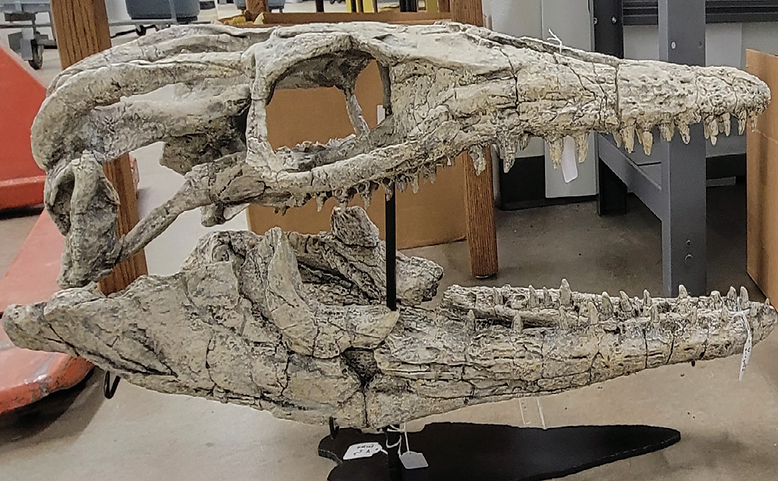
Perhaps one of the most interesting finds from Cavalier County was a mosasaur, a large aquatic reptile that lived in the oceans while dinosaurs roamed the land. More closely related to snakes and Komodo dragons than dinosaurs, mosasaurs swam using large flippers and an extremely long, stiff tail. Like dolphins and whales, they had to return to the surface to breath, and were the top predators of the seas during their time, with some species reaching lengths of close to 50 feet and displaying teeth as large as that of a Tyrannosaurus rex!
Interestingly enough, the mosasaur was found in July of 2015, when a teenager from Florida was visiting the Pembina Gorge State Recreation Area. While exploring the area, she found part of the jaw of a mosasaur! That same month, during a public fossil dig, the rest of the lower jaw was discovered, with many of the teeth still intact. Within a few days, dig participants uncovered a good portion of the skull of a mosasaur, as well as the front portion of the neck. This was an exciting discovery because only a few mosasaur skulls have been recovered in North Dakota, and this was the first from the Pembina Gorge, providing important information about the Cretaceous seaway of North Dakota.
Along with the mosasaur, other sea monsters have been found in the Pierre Formation. Remains of xiphactinus have been found near Walhalla. These large bony fish reached lengths of 20 feet and resembled huge, fanged bulldog tarpons. Fossils of plesiosaurs, huge, lizard-like reptiles, have also been found in North Dakota. In fact, Lewis and Clark stumbled upon a partial skeleton of a plesiosaur just south of the North Dakota border during their famed expedition of 1804. In more recent years, isolated bones have been uncovered in Cavalier County, including vertebrae and teeth. The remains of another huge sea creature, the giant squid known as tusoteuthis, has also been found at the Pembina Gorge Site.