
876 - Concrete Company & Railroad
Become a proud sponsor today.
Concrete’s official birth was July 21, 1908, nearly twenty years after North Dakota became a state, during a time when the railroad was chugging across the northern plains. Though, in this neck of the woods, another industry was providing jobs and resources as well. The Pembina Portland Cement Company was founded in 1899 to produce a specific type of cement called portland cement.
The story really begins in 1891 when Earle J. Babcock, state geologist, discovered cement clays in the hills of Cavalier County. He partnered with his brother, Otto Babcock, and University of North Dakota President, Webster Merrifield to manufacture cement. The Pembina Portland Cement Company was founded in 1899 and a plant was constructed on the banks of the Tongue River. Even though initial tests showed promise of a high-quality cement being produced, within a few short months, the company was in trouble, unable to acquire enough of the necessary raw materials needed to make a high-quality cement.
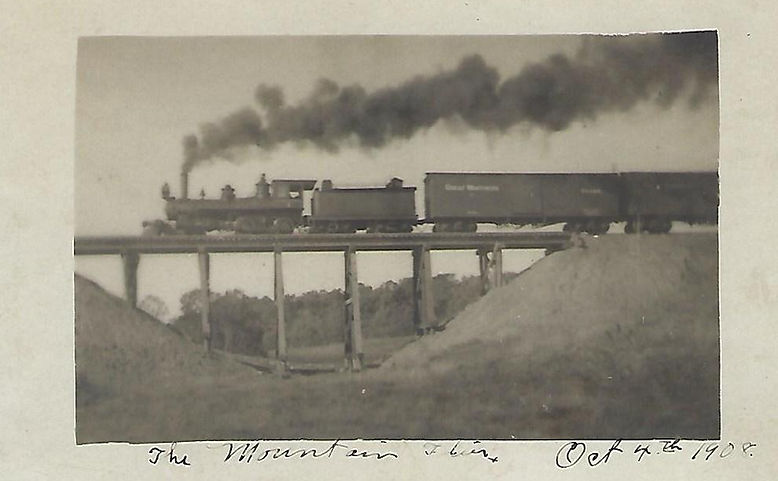
By 1907, the Pembina Portland Cement Company was in the hands of Tom Campbell and Daniel Bull. Despite production difficulties, the plant’s capacity was increased and both Bull & Campbell promoted the construction of a private railroad from Edinburg, North Dakota to the cement mine site – a distance of some 21 miles, running through the new townsite of Concrete. Named the Northern Dakota Railway, it was completed in 1908, with stock being sold to farmers along the route with the promise of great riches from revenue generated by hauling finished cement along with the commodities produced on their farms. At the hands of either false promises or bad luck, the great riches were not to be – the cement plant, which had been renamed the Northern Cement and Plaster Company, folded in the summer of 1909, leaving the railroad to struggle on its own. The main source of income was hauling the United States mail, though that contract dissolved when they were unable to keep the locomotive running on a regular basis. A motorized jitney proved just as troublesome; train service was reduced to three times per week and, towards the bitter end, just in the fall when there was farm produce to haul. The Northern Dakota Railway made its last run in November of 1919. The line was dismantled three years later. Without the railroad, the writing was on the wall for the town of Concrete.
Over the years, fires destroyed what little there had been of the community, and today, nothing of the original town remains standing, with the exception of the church and a few homes.