
864 - Dahlen Esker
Become a proud sponsor today.
When taking in the wide open spaces of North Dakota, it is hard to believe there was a time when glaciers covered much of the state. Roughly 25,000 years ago, the Lake Wisconsinan glacier did just that, especially in the eastern and northern parts of the state. While it’s easy to think nothing is left of these massive glaciers, if you know what you are looking for, you’ll see evidence of the ice sheets carved across the prairie.
Eskers are among the more interesting kinds of glacial deposits found in North Dakota. They are the ridges of gravel and sand that mark the routes of streams and rivers that flowed on, in, and beneath the glaciers, sometimes in cracks on the surface or through tunnels beneath the ice. The banks of these esker rivers eventually melted away, leaving the gravel deposits standing as ridges, the landscape inverted. What had been a valley became a ridge.
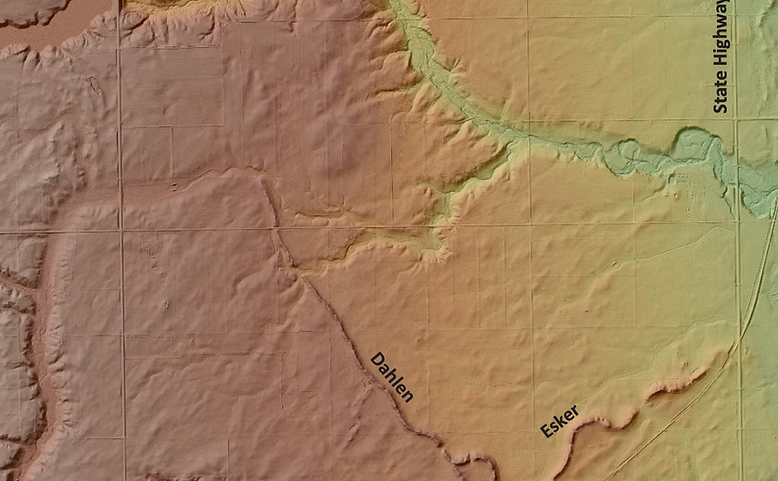
The Dahlen Esker is the most prominent esker in North Dakota and is perhaps one of the most outstanding examples in the continent. Located about halfway between Fordville and Dahlen, it can be seen as a prominent ridge where State Highway 32 crosses the Grand Forks and Walsh County line. Spanning nearly four miles long, the 400-foot-wide Dahlen Esker is hard to miss. The crest of the ridge rises to a maximum height of 80 feet and although it is generally level, numerous gaps give it an irregular appearance. This particular esker consists of a mixture of sand, gravel, glacial sediment, and boulders.
It is estimated that there are hundreds if not thousands of eskers throughout the state. Along with the Dahlen Esker, there are other notable eskers found in several North Dakota counties, including Nelson, Foster, McLean, Barnes, and Sheridan, most of them much smaller than the Dahlen.